Monday, March 19, 2012

Nature Watch: Frigatebird rescued in Sta. Cruz

A specie of migratory bird called the Great Frigatebird (Fregata minor) on March 16, 2012 at the Escandro Area, Barangay Zone 2, Sta. Cruz, Davao del Sur. According to Mr. Rey Caligado, Zoology Technician of DENR-PAWD, the bird mostly comes from neighboring countries like Taiwan or Borneo.

The said wildlife was turned over for safekeeping pursuant to the provisions of Republic Act 9147 otherwise known as the Wildlife Resources Conservation and Protection Act of 2001.


The Great Frigatebird (Fregata minor) is a large dispersive seabird in the frigatebird family. Major nesting populations are found in the Pacific (including Galapagos Islands) and Indian Oceans, as well as a population in the South Atlantic.

The Great Frigatebird is a lightly built large seabird up to 105 cm long with predominantly black plumage. The species exhibits sexual dimorphism; the female is larger than the adult male and has a white throat and breast, and the male's scapular feathers have a purple-green sheen. In breeding season, the male is able to distend its striking red gular sac. The species feeds on fish taken in flight from the ocean's surface (mostly flyingfish), and indulges in kleptoparasitism less frequently than other frigatebirds. They feed in pelagic waters within 80 km (50 mi) of their breeding colony or roosting areas.

Sunday, March 4, 2012

Crisscrossing Sarimoro Mountain Range

Two sets of climb on February 20 and 23, 2012 were organized by this club as officially instructed by the local authorities of Sta. Cruz, Davao del Sur to validate the reported tension cracks in the area. The location was at Sitio Sarimoro, Barangay Coronon; situated Northwest of the municipality and majority of the land class is extremely mountainous. The first climb was a mere rapid field assessment while the second was a corroboration climb with a team of geologists from the Mines and Geosciences Bureau conducting actual field analysis of the cracks.

Joining such a technical climb allows my group to explore more beautiful mountainscapes in Sta. Cruz which were not discovered before. Sarimoro range is a carpet of lime vegetation as seen in distant reference point. While we were standing above the Habitat for Humanity (HH) in a hill measuring some 60 masl, we saw the gorgeous 796 peak in Barangay Zone 1, the sight I and Jonas had always wanted to climb around even before we created LOGSAC. The western slope features the famous kawa-kawa mountain of Coronon, considered to be the main source of Binuangon Spring where the barangay’s potable water is wheedled out.

In a secluded portion of Coronon adjacent to sitio Sarimoro, we saw the rock face in sitio Langan positioned in a very interesting vicinity. According to local folks, that stone structure is a point where several other stone formations below are located and there are even caves in there that prompted our group to set an exploration climb anytime March 2012.

Lastly, the eastern lower slopes from HH features overlooking vistas of Coronon which include the green building of WL Foods, Franklin Baker Company, Maharlika Agri-Marine Ventures Corporation, the paved national highway and the scenic Davao Gulf.

Much as we were delighted with the result of our tension crack analysis as it is not as alarming as others have earlier thought, we were more delighted watching the many beautiful panorama of Coronon.

Thanks to those who joined the climb namely: Tolits, Pawiks, Kiba, Jonas, Melvin, Mulong, Jopacs. Special thanks also is due to the two geologists from MGB and to the Barangay Council of Coronon for providing the guides.

Wednesday, February 15, 2012

Backtrack # 10. Sibulan River Trekking to Tudaya Falls

One of the many reasons why Sibulan trail to Mt. Apo was the trail opted by extreme mountaineers was its almost one hour river trekking via the Sibulan River. From its main source Tudaya Falls, this river has been considered one of the cleanest in Mindanao. It also provides social value to the communities as several local inhabitants depend largely to the river for food, laundry and even potable water source.

Today, Sibulan river is no longer as pristine as it was five years ago. Still, a lot of people has directed to the river for survival. And with the coming of a hydro-power plant, change seemed to be just as inevitable for the river not very far from now.
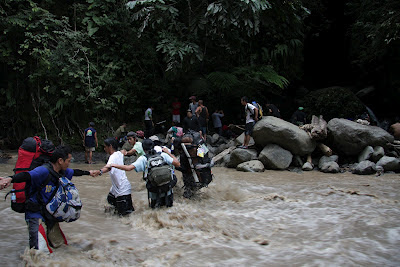
Trekking Mt. Apo nowadays via Sibulan trail cancels the first day river trekking as there are already roads established along its sideways and as I reflected, it is no longer as pristine as before. Which also means that the usual four days climb can now be done for three days via the easier Baruring route.


The last time my group joined a river trekking was February 8-9, 2008 along with Ma’am Sonia Garcia of Department of Tourism, MFSM club members and other Davao-City based mountaineering groups. LOGSAC team was then composed of the following: Kiba, John Jay, Jonas, Tolits, Undal, Papong and this blogger. My Boss Camila was also present during the climb. Our target was to gather documentations of the river and Tudaya Falls before it would totally deformed and at the same time witness the culture of the Bagobo tribe in sitio Tudaya.


The climb actually marked also the start of construction of the hydropower plant which eventually caused some delay of the trekking. There were falling rocks and debris coming from the upper portions of the surrounding mountains attributing to the unusual strong river flows and water turbidity. Several trees within the riverbanks were cut down and the river vegetation vanished. We even saw a displaced snake somewhere in Cabarisan, proof of rapid obliteration of the area’s natural trait. It was also the last time we saw the gorgeous and tiny twin waterfalls located near the Tibolo-Baruring junction.

We were supposed to stay overnight at Tudaya Elementary School but because of the delay, we camped the whole night at Tibolo-Tudaya intersection, now the site of a hydropower plant office. On the second day, we proceeded to Tudaya Falls using the Tingting route while other members continued the more strenuous river trekking.

After enjoying the alluring experience at Tudaya Falls, the team stayed at Tudaya Cultural Village for almost two hours to witness tribal offerings. At that time, tribal leader Apo Adok was still alive and kicking in the place called “live-in”. Today, with the coming of the hydropower plant, “live-in” was relocated.

Although there was fun during the climb, my LOGSAC team was able to witnessed the many changes of Sibulan river brought about by industrialization. The tiny sting suffered by this very important piece of nature is very painful. It might be unhurried, but the sudden disappearance of Bagobo culture is excruciating. Tsk tsk…