Bislig City is the Mecca of Mindanao Birding, as a good friend Alden would
put it. Indeed, it is true. I affirmed it just recently when my group The Big
Year Davao was invited by Atty. Conrad Cejoco, the good Board Member of Surigao
del Sur whom I met sometime 2009. This provincial legislator is on to a serious
fight for conservation particularly in the City of Bislig where environmental
challenges are obvious. I wish other political leaders learn from him.
The purpose of Atty. Conrad’s invitation is for us to document birds and
other wildlife in Bislig which would soon be utilized as baseline for a more
detailed conservation plans of the city in particular and the province of
Surigao del Sur in general. Thankfully, 3 of the main pillars of The Big Year
Davao were there to join the activity in bird expert Pete Simpson, wildlife
photographer Alden Fernandez and conservationist Joshua Donato. This team is
somehow perfect to quench the outputs that Sir Conrad wanted from us.
The first day of travel had me joining Alden in his car while Joshua
joined Pete in his SUV. We arrived in Bislig by 10:30 AM with Sir Conrad
meeting us at the Bislig Government Center. After a productive conversation and
pre-arranged lunch in Tinuy-an Falls, we started scanning for birds in a site
just above Tinuy-an Waterfalls. Immediately we were greeted with good sights of
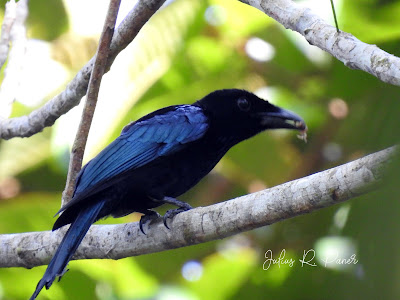
Yellowish Bulbul, Hair-crested Drongo, Buzzing Flowerpecker, Philippine Trogon, Black-naped Monarch
and the precious Short-crested Monarch.

The next few hours on day 1 were spent trekking to sitio Sote. I
remembered the place very well as it was venue of our immersion program with
Mountaineering Federation of Southern Mindanao in year 2009. Nothing has
changed much except that the forest cover has decreased dramatically. On the
way to our transient hut we crossed a calm but deep river system that connects
to Tinuy-an Falls. Prior to crossing the river through a canoe a lone Southern
Silvery Kingfisher showed up but very busy catching Damselflies for afternoon
snacks. Above the river is flock of mixed birds such as Philippine Leaf Bird,
Whiskered Tree Swift, Mindanao Hornbill, Philippine Green Pigeon, Pink-bellied
Imperial Pigeon and Green Imperial Pigeon. Another 5 minutes of trekking from
the river brought us to a hut owned by a tribal leader in Sote where we stayed
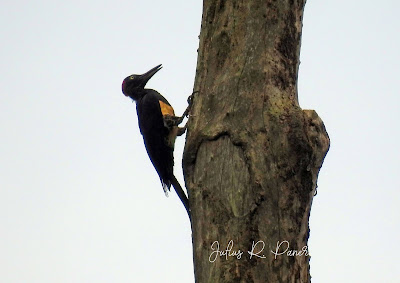
overnight. The perimeter of the hut is a good refuge of Blue-crowned
Racket-Tail, Coleto, White-bellied Woodpecker, Mindanao Hornbill, Black-naped
Oriole, Philippine Coucal and White-eared Brown Dove, among others. After a
good dinner Pete spearheaded an inventory of night birds in the adjacent
forest. The evening cast of owls were almost complete, but the presence of a
Mindanao Tarsier stole the show.


Day 2 was a lot bloodier. The trekking to a secondary growth dipterocarp
forest was humid with fewer birds. Highlight was an appearance of Black-headed
Tailorbird, Yellow-breasted Fruit Dove, Striated Wren-Babbler, White-eared
Brown Dove, Philippine Pitta, Black-faced Coucal, Pink-bellied Imperial Pigeon,
Mindanao Hornbill and Writhed Hornbill. At around 10:30 in the morning we
headed back to the bunkhouse and left for lunch at Mangagoy where Atty. Conrad
met us. We completed the second day with a quick visit in Lake 77 and Bislig
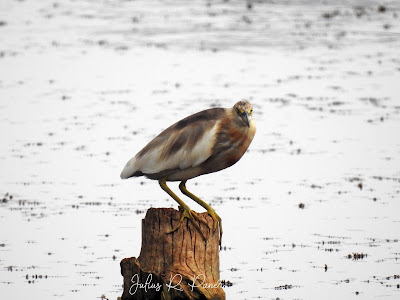
Airport to see Whistling Ducks, Philippine Ducks, Purple Heron, Black-naped
Monarch and few Whiskered Terns in summer plumage. The airport runway served as
viewing site for Philippine Night Jar, Watercock, Paddyfield Pipit, Barred Rail
and Clamorous Reed Warbler. We concluded the day with another sumptuous seafoods
dinner at Sir Conrad’s house and left for River View Inn after some productive
conversation.




On to the 3rd day, a long drive from River View Inn to
PICOP’s Road 4 which according to Pete one of the best birding sites in
Surigao. At the old cemetery we started the day’s session by recording special
birds such as Green Imperial Pigeon, this time with a distant but good
background for us to nail some good shots. Handsome Sunbird and Metallic-winged
Sunbird are common in the place, too, along with Yellow-breasted Fruit Dove,
Philippine Green Pigeon, Asian Koel and Black-faced Coucal. Going north of the
road gave us distant view of Mindanao Hornbill, Writhed Hornbill and Rufous
Hornbill. We also heard constant calls from Azure-breasted Pitta, Little Slaty
Flycatcher and Mindanao Blue Fantail. After close to an hour of staying in Road
4 we finally saw the Celestial Monarch, not being able to perch for a photo
session with us but the way it encircled above us was terrible. Bucket. That
was good for a suspension of birding and got something for a good breakfast of
egg and luncheon meat.

It was getting hot after our breakfast and what better way to cool down
was to stay inside a forest trail. The most notable observation was a call from
an immature Mindanao Wattled Broadbill which Pete refused to confirm until seen
directly. Unfortunately the young bird did not show up. We recognize bird
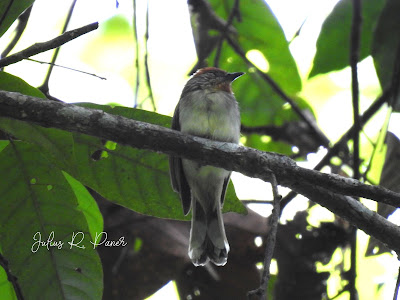
activities inside the forest with good sightings of Rufous Paradise Flycatcher,
Rusty-crowned Babbler, Mindanao Pygmy Babbler, Yellow-wattled Bulbul, Yellowish Bulbul, Mindanao Blue Fantail and
Rufous-tailed Jungle Flycatcher. We left the forest back to the car park and
took an equally excellent lunch of chicken-pork adobo and went for another
round of bird check in the cemetery to be reunited with Philippine Trogon,
Hair-crested Drongo and an illegally-cut Red Lawaan Tree.




Pete wasn’t convinced to proceed to Road 42 due to a very limited time.
We had to drive back to River View Inn to prepare talking points and
presentation for another set of meeting with Sir Conrad, the City Administrator
(in behalf of the Mayor), the City Tourism Officer and the Manager of Tinuy-an
Waterfalls.
We were supposed to leave early for Davao on the 4th day but I insisted
to go back to Tinuy-an for further birding, hoping that this time we would spot
good angle of beautiful birds there. An early morning trek to a dilapidate
resort in the upstream part of Tinuy-an had us seeing the Black-chinned Fruit
Dove, Brown Tit-Babblers, Rufous-fronted Tailorbird, Olive-backed Flowerpecker
and Southern Silvery Kingfisher, not to mention the Philippine Honey Buzzard
being harassed by a Hair-crested Drongo. And just as we were about to take a
final groufie opposite the Tinuy-an Falls arc we were treated with a good view
of Yellow-breasted Fruit Dove.




To sum it up, this trip is totally different from the usual birding that
our team has undertaken in the past. We were there not just to document birds
and other wildlife, but at the same time share inputs about doable conservation
mechanisms to save the remaining forests of Bislig. In unison we agreed that
ecotourism is a viable strategy towards conservation, and that the Indigenous
Peoples (IPs) should take the prime step in order to fast track projects and
activities. The presence of Paper Industry Corporation of the Philippines
(PICOP) in Bislig long time ago had taken a toll to its rich biodiversity from
the mid-elevation forests down to the coastal sides where the seawater turned
into dark brown color.
Lastly, Pete’s report
saw 113 birds recorded in our 3 and a half day-tour, 66 of which are endemic in
the country. This cumulates only five sites namely: Tinuy-an Falls/Resort,
Sitio Sote, Lake 77, Bislig Airport and Road 4 Cemetery. Again, if all of us
are bent on keeping all these birds stay in Bislig the best step is to protect
the remaining forest in whatever means humanly possible. And that includes,
among other things, involving the IPs in conservation, otherwise, they will
keep cutting trees in all these sites.
x


